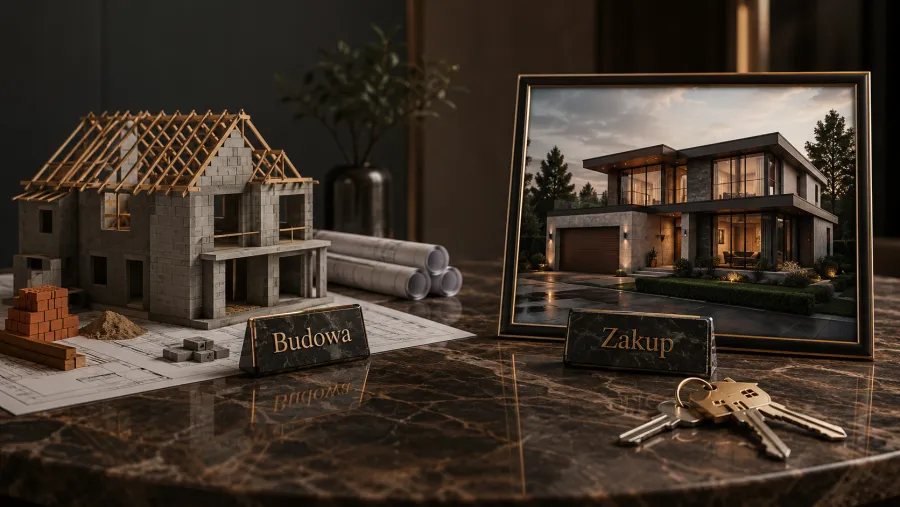
Two completely different models — and why confusing them costs investors a fortune
Almost every investor asks themselves this question at the stage when the plot is already bought, the design is sitting in a drawer or still being drafted, and one thought keeps circling: who should be entrusted with it all. Online and in construction forums, opinions run to extremes — some swear by developers, saying ‘everything was ready and I didn’t have to deal with anything,’ others warn that ‘they bought a catalog house and still regret every mismatched wall.’ The truth, as usual, lies on neither side of the argument, but in what you actually expect from your own home.
Before we answer the question in the title, we need to dismantle a simplification that persists in the industry: this isn’t a choice between a ‘good company’ and a ‘bad company.’ It’s a choice between two completely different models of responsibility, control, and ownership of decisions. A general contractor building to your individual design and a developer selling a turnkey house from a ready-made concept differ at every point in the process — from the moment the contract is signed, through who decides on materials, to who you’ll call when something goes wrong three years after handover. We’ll say it plainly, because this industry too often avoids uncomfortable comparisons so as not to alienate either side.
A development company building ‘turnkey’ operates like a product business. It has a ready design, a ready plot (or several to choose from), a predetermined finishing standard, and a schedule that results from building several or a dozen identical houses at once. You’re buying something that largely already exists on paper, and sometimes in reality — just not yet on your plot. It’s a transactional model: you sign the contract, pay installments on schedule, and get the keys.
A general contractor building to your individual design works completely differently. The starting point isn’t a finished product, but a design created for a specific plot, a specific family’s needs, and a specific budget. The GC doesn’t sell you a house — it builds the house that you (together with an architect) designed, and takes responsibility for delivering that particular vision, with all its custom solutions, individual installations, and material decisions that you make along the way.
The problem is that many investors compare these two models purely on price per square meter, without understanding that they’re comparing two different products. It’s a bit like comparing a chain-store suit with a bespoke suit purely on fabric price — ignoring the fact that one is designed for your figure, and the other for an average client in size L.
Control and customization — where you actually lose influence
In the development model, your control usually ends with choosing the plot, possibly mirroring the room layout, and a finishing package from a limited list of options. Load-bearing walls, installation layout, ceiling heights, window spacing — all of this is already designed and optimized for repeatability, because the developer builds the same design over and over. Any change beyond the standard means either a surcharge disproportionate to the actual labor cost, or a flat refusal — because it would disrupt the schedule of the entire development, not just your house.
In the general contractor model, control begins as early as the concept design stage and continues throughout the entire construction process. It’s you, together with the architect and contractor, who decide on the functional layout, ceiling heights, installation solutions, heating system, acoustics, and natural light. A good premium-segment general contractor doesn’t just allow this — they actively advise where it’s worth investing and where the investor would be overpaying for solutions with no real practical value. That’s the fundamental difference: a catalog turnkey house is designed for an average client, a house built with a general contractor — for you.
Not sure which model fits your plot?Let’s find out together.
GENERAL CONTRACTOR OR DEVELOPER — A STRAIGHT CONVERSATION
In a single conversation, we’ll tell you honestly whether your design, plot, and budget are better suited to an individual general contracting model or a ready turnkey house.
Price, risk, and what no one tells you at the first meeting
This brings us to an uncomfortable truth that needs to be named directly. Developers’ ‘turnkey’ house offers can be cheaper on paper, because they rely on repeatability and scale — the same design, the same materials bought wholesale, the same crews moving from site to site without downtime. That’s a real cost advantage, not an illusion.
But that lower entry price often hides risk shifted onto the investor in another form — through a finishing standard lower than expected, materials swapped ‘due to unavailability’ for cheaper equivalents, and contracts written to protect the developer, not the client. Changes after signing the contract are often priced in a way that effectively discourages any personalization, even minor ones.
Building a house with a premium-segment general contractor usually means a higher starting price, because there’s no economy of scale here — each project is priced individually, materials are selected for specific solutions, and the schedule is built around a single build, not a dozen at once. Risk doesn’t disappear in this model, but it’s distributed differently: it lies mainly in the quality of the contractor you choose. A good GC with a transparent cost estimate and a clear contract minimizes surprises. A bad one — and there’s still no shortage of those in Poland — can generate just as many problems as the worst developer, only at a higher entry budget.
Comparison table — general contractor vs. turnkey developer
Criterion
General contractor (individual design)
Developer (catalog turnkey house)
Starting price
Higher, priced individually for the project
Lower, thanks to scale and repeatability
Delivery time
Depends on project complexity, usually a longer preparation process
Shorter, as the design and logistics are ready
Personalization
Full — layout, installations, materials, details on request
Limited to the options list in the price sheet
Quality control
Direct, investor has insight at every stage
Indirect, based on trust in the developer’s standard
Risk
Concentrated on choosing the right contractor
Concentrated on contract quality and material substitutions
Flexibility of changes during construction
High, changes possible on an ongoing basis
Low or costly, disrupts the schedule of multiple builds
Who is it for — when each model actually makes sense
The turnkey development model works well when the priority is a predictable budget, speed, and acceptance of a standard architectural solution. If the plot is typical, the family has no particular functional requirements, and the house is meant to be an efficiently delivered, well-priced product — that’s a fair and rational path. There’s nothing wrong with it, as long as the investor enters the transaction aware of what they are, and aren’t, buying.
A general contractor makes sense where the plot is atypical — a slope, difficult access, an unusual orientation to the compass points — or when the investor has a specific vision for the house that no catalog can satisfy. It also makes sense when the quality of workmanship and materials is the overriding priority over price, and the investor wants real influence over every decision, rather than choosing from a closed list of options. It’s the natural choice for the premium segment — not because it’s more expensive, but because premium means being tailored to you, not averaged out.
There’s also a third group of investors — those who choose the development model hoping to save money, and end up with a house they have to renovate anyway after handover, because the standard turned out to be insufficient. That’s the most expensive scenario possible, because you pay twice — once for the house, and again to fix it to the standard it should have had from the start.
How Sigvin approaches this topic
We operate as a general contractor building single-family turnkey houses, but in an individual-design model — we don’t sell ready-made catalog concepts. We believe that in the premium segment, a catalog approach doesn’t make sense, because a client investing in a top-class house expects a house designed for them, not for an averaged group of buyers.
That doesn’t mean we avoid talking about costs — quite the opposite. At the first meeting, we tell you plainly how much a specific project will actually cost, which decisions generate the biggest costs, and where the investor can save without losing quality. The cost estimate we present is transparent from the very first line item — with no hidden material substitutions and no margin for ‘surprises,’ which at many companies is simply a markup already built in for future negotiations.
Our job as a general contractor is to protect the investor’s interest at every stage — from verifying the design for feasibility, through selecting trade contractors, to quality supervision on site. We’re not a seller of a finished product. We’re a partner who takes responsibility for making sure the house you designed is actually built as intended — without compromises forced by the logic of scale.
AndrzejCompany Owner
We don’t sell one model to everyone — sometimes the most honest advice is admitting that something else fits better than what we happen to do.
I’d rather lose a client at the first meeting than build a house that doesn’t match what they actually needed.
If you’re wondering whether your design and your plot are better suited to an individual general contracting model or a ready-made developer solution — let’s talk before you make a decision, not after something goes wrong. Book a free consultation with Sigvin. We’ll assess your project, plot, and budget honestly, without pushing you toward one particular model just because it’s what we happen to sell. Sometimes the best advice we can give is an honest answer that something other than what we do would work better for you — and that’s part of our job too.